


Solid & Veneer Wood
We source premium hardwoods from sustainable global forests, graded to the National Hardwood Lumber Association (NHLA) century-old grading system for full transparency.
NHLA Grading System
All hardwood lumber is graded by clear face cut yield, not subjective appearance, ensuring consistent, traceable quality across every order.
Note: NHLA grading measures lumber yield and surface clarity, not mechanical strength. FAS and No.1 Common lumber of the same species have identical density and durability.
Core Wood Species
We select wood species tailored to indoor and outdoor use cases, each chosen for its specific performance properties.
White Oak Closed-pore premium oak for dining tables, cabinetry, and durable exposed surfaces. Quercus spp.
- Origin
- Eastern North America, with premium Appalachian and northern selections for tighter color control.
- Physical Specs
- Air-dry density approx. 0.68-0.75 g/cm3; Janka hardness approx. 1,290-1,360 lbf; hard, heavy, and wear resistant.
- Grain
- Bold cathedral grain, straight-grain options, and distinctive medullary ray flecks on quarter-sawn faces.
- Key Benefits
- Closed tyloses in the pores give better water and rot resistance than red oak; a strong benchmark for premium visible furniture parts.
- Ideal Use
- Dining tables, cabinetry, sofa frames, doors, and lightly protected outdoor pieces with suitable finishing.
- Grade Specification
- FAS or Select for visible surfaces; No.1 Common only for concealed or structural frame components.
Red Oak Open-grain value oak for indoor frames, cabinetry, and stained furniture. Quercus spp.
- Origin
- Eastern and central North America; one of the most abundant commercial hardwood groups.
- Physical Specs
- Air-dry density approx. 0.70-0.74 g/cm3; Janka hardness approx. 1,220-1,290 lbf; strong everyday furniture performance.
- Grain
- Coarse open pores, warm pinkish to reddish brown heartwood, and less pronounced ray figure than white oak.
- Key Benefits
- Abundant supply, strong value, good machining, and excellent stain acceptance across many finish tones.
- Ideal Use
- Indoor sofa frames, mid-range solid wood furniture, cabinetry, flooring, and veneer-core stock.
- Note
- More open pore structure than white oak; best kept to indoor dry environments unless heavily sealed.
Black Walnut Dark, stable, premium hardwood for refined furniture and veneers. Juglans nigra
- Origin
- Midwestern and eastern United States hardwood forests.
- Physical Specs
- Air-dry density approx. 0.55-0.61 g/cm3; Janka hardness approx. 1,010 lbf; moderate density with excellent stability.
- Grain
- Smooth flowing waves, occasional curl, burl, and bird's-eye figure; color ranges from tan to deep chocolate brown.
- Key Benefits
- Excellent dimensional stability, low cracking risk, and a natural oil-rich hand feel that gains depth with age.
- Ideal Use
- Premium veneers, armrests, tabletops, cabinet fronts, and minimalist or luxury furniture forms.
- Grade Specification
- FAS for exposed solid parts; color-matched premium veneer for large visible surfaces.
Teak Naturally oily outdoor hardwood for moisture-prone applications. Tectona grandis
- Origin
- Myanmar, Indonesia, India, and certified tropical plantations; Myanmar Mandalay teak is the premium reference.
- Physical Specs
- Air-dry density approx. 0.61-0.67 g/cm3; Janka hardness approx. 1,070 lbf; unusually low shrinkage among commercial hardwoods.
- Grain
- Straight to slightly wavy, coarse, and oily; fresh cuts read golden brown and deepen with time and light.
- Key Benefits
- Natural oil and silica content support excellent rot, moisture, termite, and weather resistance.
- Ideal Use
- Premium outdoor furniture, bathroom furniture, yacht-style interiors, decking, and high-moisture applications.
- Grade Specification
- Grade A heartwood for exposed premium work; avoid sapwood in outdoor or wet applications.
Ash Pale, tough hardwood for frames, curved parts, and modern visible grain. Fraxinus spp.
- Origin
- Northeastern North America and northern Europe.
- Physical Specs
- Air-dry density approx. 0.60-0.67 g/cm3; Janka hardness approx. 1,320 lbf; tough and impact resistant.
- Grain
- Straight, clean, pale cream to light yellow, with minimal color variation and a crisp open-grain figure.
- Key Benefits
- Excellent steam-bending ability, shock resistance, and durability for high-frequency use.
- Ideal Use
- Sofa frames, chair frames, bent components, armrests, and high-value Scandinavian or modern styles.
- Grade Specification
- FAS or Select for visible pale surfaces; No.1 Common for structural frames and hidden rails.
Cherry Fine-grained hardwood that warms and deepens beautifully with age. Prunus serotina
- Origin
- Northeastern United States, especially Pennsylvania and New York.
- Physical Specs
- Air-dry density approx. 0.50-0.56 g/cm3; Janka hardness approx. 950 lbf; fine texture and excellent machining.
- Grain
- Fine, smooth grain, light pinkish brown when new, developing a warm golden red-brown tone with light exposure.
- Key Benefits
- Excellent dimensional stability, strong finish adhesion, and a refined color that ages beautifully.
- Ideal Use
- Mid-century and vintage-style furniture, cabinet fronts, accents, decorative components, and veneers.
- Grade Specification
- FAS or color-sorted Select for visible faces; allow natural darkening as part of the design intent.
Maple Clean, pale hardwood for durable work surfaces and contemporary cabinetry. Acer spp.
- Origin
- Eastern U.S. and Canada, especially colder northern growing regions for hard maple.
- Physical Specs
- Hard maple commonly reaches approx. 1,450 lbf Janka; soft maple is usually lighter and easier to machine.
- Grain
- Creamy white to light tan, close fine texture, generally straight grain, sometimes with curly or bird's-eye figure.
- Key Benefits
- High wear resistance in hard maple; maple-like appearance at better value in soft maple.
- Ideal Use
- Tabletops, work surfaces, cabinetry, butcher blocks, chair parts, toys, and high-contact components.
- Grade Specification
- FAS or color-sorted Select for visible panels; careful drying and acclimation are required to control movement.
Birch Light, fine-textured hardwood for panels, cabinetry, and plywood-facing work. Betula spp.
- Origin
- Northern North America and northern Europe, depending on species and supply chain.
- Physical Specs
- Air-dry density commonly approx. 0.60-0.67 g/cm3; yellow birch Janka hardness approx. 1,260 lbf.
- Grain
- White sapwood and light reddish-brown heartwood; fine uniform texture with plain, wavy, or lightly curly figure.
- Key Benefits
- Excellent stain acceptance, strong screw holding, and dependable value for cabinets and engineered panels.
- Ideal Use
- Furniture panels, cabinet doors, millwork, flooring, turnings, toys, and premium plywood faces.
- Grade Specification
- Color-sorted Select or FAS for exposed faces; use stable kiln-dried stock for broad panels.
Beech Dense, uniform hardwood for chairs, bentwood parts, and production furniture. Fagus spp.
- Origin
- Europe and temperate hardwood regions; steamed European beech is common in furniture supply.
- Physical Specs
- Air-dry density approx. 0.69-0.72 g/cm3; Janka hardness commonly around 1,300-1,450 lbf.
- Grain
- Fine, even, usually straight grain with pale cream to pinkish-tan color; steamed beech becomes warmer and more uniform.
- Key Benefits
- Excellent bending, strong joinery, uniform texture, and high repeatability for production furniture.
- Ideal Use
- Chair frames, bentwood components, sofa frames, drawers, legs, workbenches, toys, and kitchenware.
- Note
- Not naturally durable outdoors; use indoors or specify full sealing and correct moisture control.
Mahogany Warm reddish premium hardwood for classic furniture and decorative panels. Swietenia / Khaya spp.
- Origin
- Central America, South America, and African commercial alternatives depending on legal supply.
- Physical Specs
- Moderate density with good stability; hardness varies significantly by exact species and source.
- Grain
- Straight to interlocked grain with reddish brown color, smooth texture, and a classic polished depth.
- Key Benefits
- Excellent workability, carving performance, dimensional stability, and a refined traditional furniture appearance.
- Ideal Use
- Case goods, carved details, veneers, cabinet fronts, doors, and premium decorative accents.
- Grade Specification
- Specify exact species and legal-origin documentation; use Select & Better or equivalent for visible faces.
Pine Lightweight softwood for painted, rustic, or value-focused furniture. Pinus spp.
- Origin
- North America, Europe, and plantation softwood regions; species ranges from white pine to southern yellow pine.
- Physical Specs
- Air-dry density approx. 0.35-0.51 g/cm3; Janka hardness approx. 380-870 lbf depending on species.
- Grain
- Light yellow to reddish brown, straight grain, visible growth rings, and knots unless clear grades are specified.
- Key Benefits
- Lightweight, easy to work, broadly available, and useful for rustic, painted, or value-focused construction.
- Ideal Use
- Painted furniture, rustic shelving, kids' furniture, utility frames, paneling, and farmhouse-style pieces.
- Note
- Soft surface dents easily; avoid for premium exposed tabletops unless the design intentionally wants rustic character.
Cedar Aromatic, naturally durable softwood for linings and light outdoor use. Cedrus / Thuja spp.
- Origin
- North America, Europe, and Asia depending on species; western red cedar is common in outdoor supply.
- Physical Specs
- Generally lightweight and stable; hardness is modest, so exposed surfaces can dent under heavy use.
- Grain
- Straight grain, warm reddish to pinkish brown tone, visible growth bands, and a naturally aromatic character.
- Key Benefits
- Natural decay and insect resistance, low density, easy machining, and strong dimensional stability.
- Ideal Use
- Closet linings, chests, outdoor accents, light patio pieces, paneling, and storage furniture.
- Note
- Too soft for premium dining tops or hard-wearing visible work surfaces.
Hickory/Pecan Extremely tough hardwood for high-stress furniture parts and rugged grain. Carya spp.
- Origin
- Eastern United States, especially central and southern hardwood regions.
- Physical Specs
- Air-dry density approx. 0.75 g/cm3; Janka hardness often 1,820 lbf or higher; among the heaviest American hardwoods.
- Grain
- White to brown sapwood with pale to reddish-brown heartwood; strong contrast and an active open-grain look.
- Key Benefits
- Outstanding strength, shock resistance, screw holding, and steam-bending capability for high-stress parts.
- Ideal Use
- Chair parts, stools, dowels, legs, flooring, tool-handle-grade components, and rugged cabinet details.
- Note
- Harder to dry, machine, and glue; specify only when toughness is worth the added production complexity.
Elm Tough, visually active hardwood for traditional joinery and expressive panels. Ulmus spp.
- Origin
- Eastern to midwestern United States and temperate Asian supply chains, depending on species.
- Physical Specs
- Air-dry density approx. 0.56-0.63 g/cm3; Janka hardness approx. 830-1,000 lbf; moderately heavy and tough.
- Grain
- Interlocked or straight grain, coarse texture, reddish to dark brown heartwood, and strong visual movement.
- Key Benefits
- Excellent bending and shock resistance; interlocked grain makes it difficult to split and visually expressive.
- Ideal Use
- Cabinetry, table panels, accent furniture, chair parts, shelving, millwork, and traditional joinery styles.
- Grade Specification
- Select for consistent visible color and grain; confirm species when sourcing Asian elm or reclaimed elm.
Alder Soft, even hardwood that stains well for value-focused visible furniture. Alnus rubra
- Origin
- Pacific Northwest; the most abundant commercial hardwood in that region.
- Physical Specs
- Air-dry density approx. 0.41 g/cm3; Janka hardness approx. 590 lbf; medium-density, relatively soft hardwood.
- Grain
- Fairly straight, uniform texture, light brown with yellow or reddish tones; little boundary between sapwood and heartwood.
- Key Benefits
- Machines cleanly, turns well, glues reliably, stains toward walnut or cherry tones, and dries with good stability.
- Ideal Use
- Cabinetry, doors, shutters, moulding, furniture frames, turned parts, carvings, and value-focused visible wood.
- Grade Specification
- Color-matched clear or knotty grade depending on the design; avoid soft-impact surfaces for heavy-use tabletops.
Poplar Workable paint-grade hardwood for interior rails, panels, and case goods. Liriodendron tulipifera
- Origin
- Widespread throughout the Eastern United States.
- Physical Specs
- Air-dry density approx. 0.42 g/cm3; Janka hardness approx. 540 lbf; light to medium density.
- Grain
- Medium-to-fine straight grain, creamy sapwood, and pale yellow-brown to olive heartwood that browns with light.
- Key Benefits
- Very workable, easy to glue and machine, stable after drying, and one of the best paint-grade hardwood options.
- Ideal Use
- Paint-grade furniture, cabinet frames, moulding, internal rails, drawer parts, carvings, and edge-glued panels.
- Note
- Not a premium exposed-surface wood unless painted, stained dark, or intentionally selected for color variation.
Rubberwood Plantation hardwood for value solid-wood panels and indoor furniture. Hevea brasiliensis
- Origin
- Southeast Asian and tropical plantation supply after latex production ends.
- Physical Specs
- Air-dry density approx. 0.55-0.65 g/cm3; Janka hardness approx. 960 lbf; medium-density plantation hardwood.
- Grain
- Light cream to pale tan with fine, uniform grain and low natural figure; commonly edge-glued into panels.
- Key Benefits
- Good value, consistent machining, strong glue performance, and useful sustainability story from plantation reuse.
- Ideal Use
- Indoor dining sets, painted furniture, children's furniture, cabinet panels, shelves, and laminated components.
- Note
- Not naturally durable outdoors; requires correct kiln drying, anti-fungal treatment, sealing, and indoor use discipline.
Acacia Dense, dramatic hardwood for solid panels and rustic modern furniture. Acacia spp.
- Origin
- Vietnam, Southeast Asia, Australia, and other plantation or regional hardwood sources; species varies widely.
- Physical Specs
- Air-dry density approx. 0.65-0.85 g/cm3; Janka hardness approx. 1,100-1,750+ lbf depending on exact species.
- Grain
- Bold color contrast, golden to reddish brown tones, and frequent interlocked or wavy grain patterns.
- Key Benefits
- Dense, hard, visually dramatic, and strong value for mass-market solid wood and butcher-block style panels.
- Ideal Use
- Dining tables, benches, outdoor-style collections with proper finish, cutting-board-like panels, and rustic modern furniture.
- Grade Specification
- Require species identification, moisture control, and color-matched panels; disclose short-board lamination where used.
Sapele Mahogany-like reddish hardwood for veneers, doors, and premium accents. Entandrophragma cylindricum
- Origin
- West and central Africa; commonly used as a mahogany-family alternative in furniture and architectural work.
- Physical Specs
- Specific gravity approx. 0.61-0.67; Janka hardness approx. 1,360-1,410 lbf; dense and structurally substantial.
- Grain
- Reddish brown with fine uniform texture; quarter-sawn boards can show a ribbon-stripe figure.
- Key Benefits
- Premium mahogany-like warmth, good finishing, strong veneer potential, and a more available commercial supply path.
- Ideal Use
- Cabinet fronts, veneers, case goods, doors, architectural millwork, decorative panels, and premium accent parts.
- Grade Specification
- Select & Better or FAS-equivalent for visible faces; require legal origin documentation for imported tropical stock.
Ebony Exceptionally dark, dense accent wood for inlays and small luxury details. Diospyros spp.
- Origin
- Tropical Africa and Asia, depending on species and legal supply.
- Physical Specs
- Very high density and hardness; commonly too heavy and scarce for large furniture structures.
- Grain
- Nearly black to dark brown, fine textured, and visually quiet when polished.
- Key Benefits
- Rare deep color, excellent luxury signal, and strong contrast against paler furniture woods.
- Ideal Use
- Inlays, handles, decorative trim, small turned parts, and accent details.
- Grade Specification
- Use only documented legal supply; avoid large-format claims or structural use unless exact species and stock are verified.
Rosewood Rich decorative hardwood for veneers, accents, and heirloom-style details. Dalbergia spp.
- Origin
- Tropical Asia, South America, and Africa depending on species; many sources are legally restricted.
- Physical Specs
- Generally dense, hard, and oily; properties vary significantly across Dalbergia species.
- Grain
- Reddish, purplish, or chocolate brown with dark streaks, oily luster, and dramatic figure.
- Key Benefits
- Exceptional decorative depth, natural polish, strong aroma in some species, and high perceived luxury.
- Ideal Use
- Premium veneers, inlays, small case goods, musical-instrument-style accents, handles, and trim.
- Grade Specification
- Require strict legal-origin documentation; avoid broad sourcing claims unless the exact species and permits are confirmed.
Note: Swatches are cropped from supplied wood samples for visual orientation. Wood tone and grain vary by species, origin, board cut, grade, kiln drying, and finish system.
Kiln Drying & Moisture Control
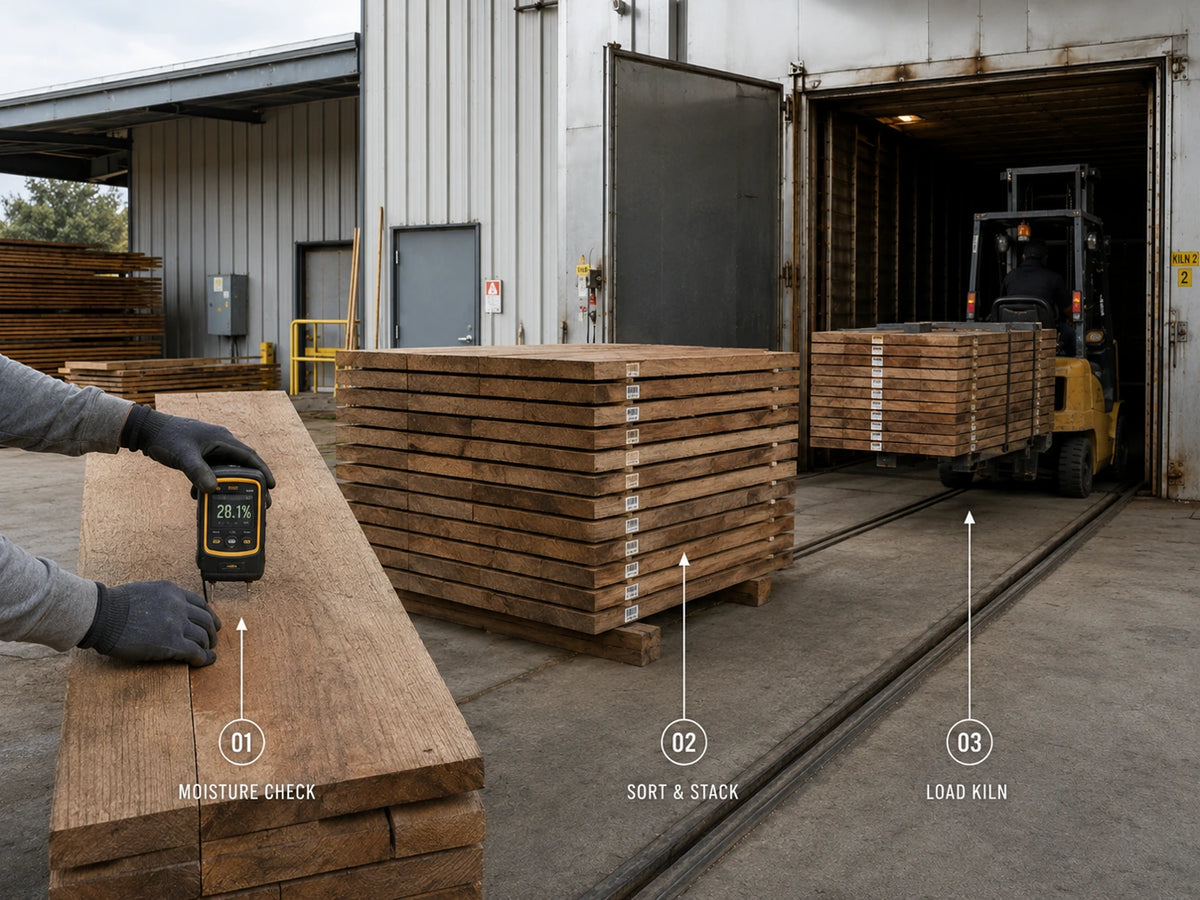
Moisture is controlled before the wood is built.
# US market standard
Per USDA Forest Products Laboratory and AWI industry standards, finished furniture moisture content is precisely controlled at 6%–9%, matched to typical 30%–50% indoor relative humidity in US homes for long-term dimensional stability.
# Drying process
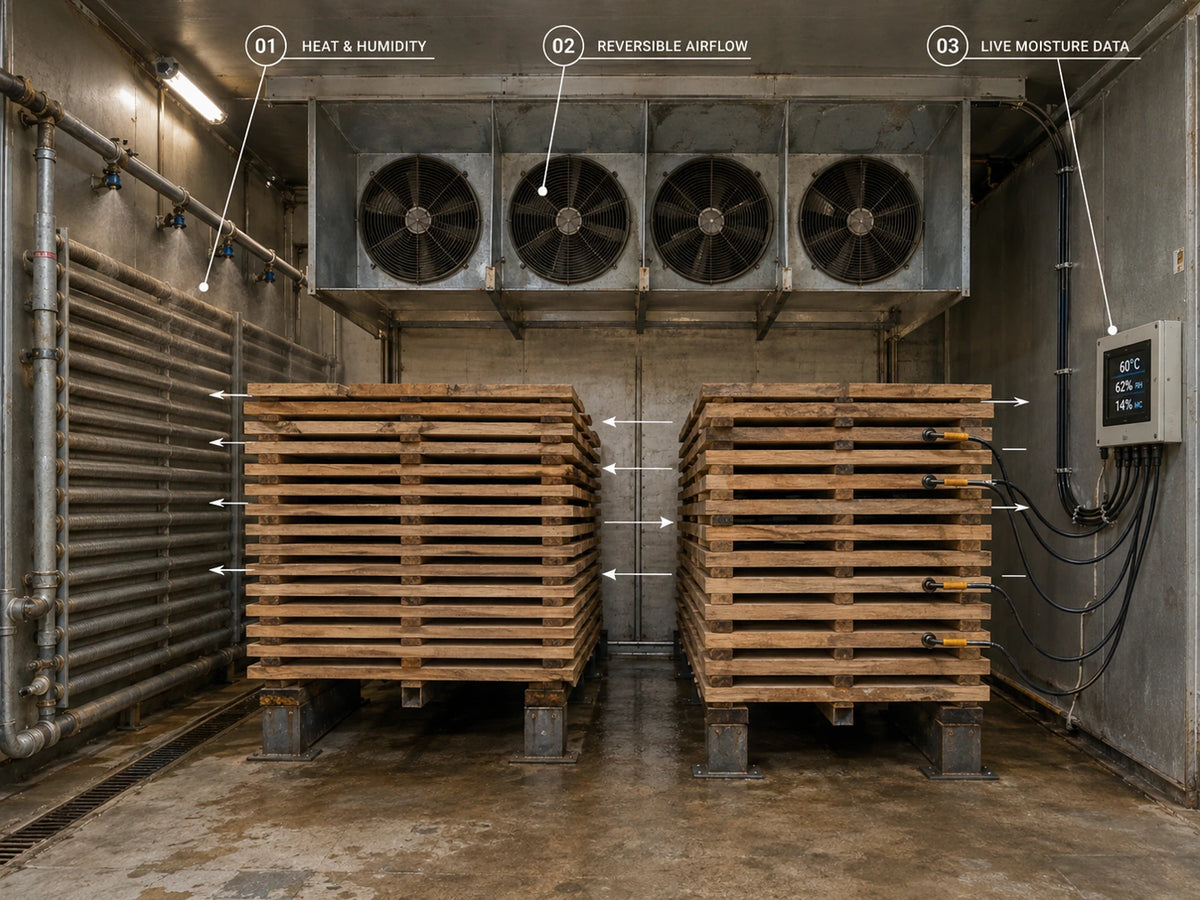
- Pre-heating stage: Low temperature and high humidity to soften wood and prevent surface checking.
- Gradient drying: Three-stage temperature ramp and humidity reduction, bringing moisture content from ~30% green lumber to target levels, with temperature rise limited to ≤2°C per hour.
- Conditioning: After kiln exit, lumber is stored in a climate-controlled room for 7–15 days to release internal stress and equalize moisture content within ±1% across the board

# Quality check
Every lumber batch is tested with a pin moisture meter at multiple points upon receipt. Out-of-spec batches are returned to conditioning and rejected for production.
Wood Veneer Specifications
Real wood veneer starts with thickness, matching, and a stable core.

Thickness
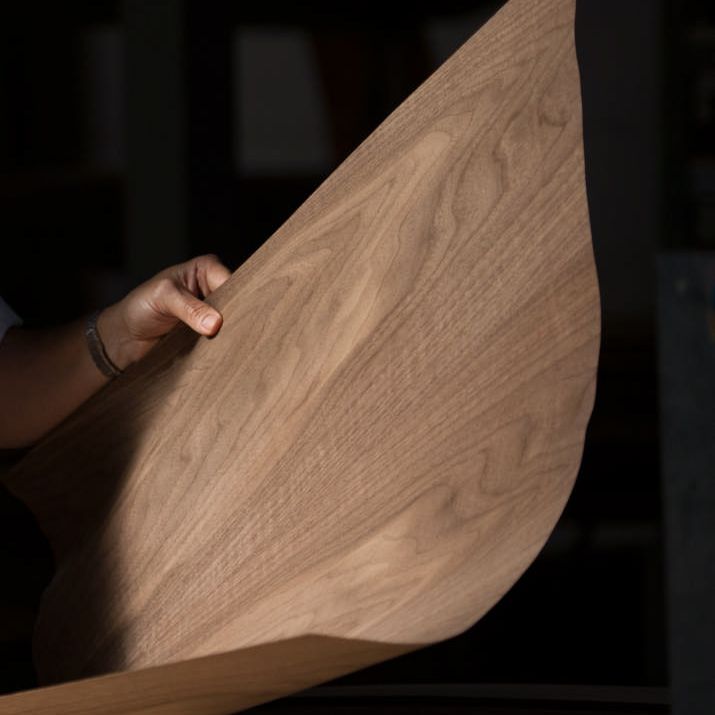
0.6mm natural solid wood veneer, thicker than the industry standard 0.3mm, for deeper grain texture and the ability to be sanded and refinished.
Matching
Book-matched or run-matched grain alignment. All veneer for a single piece of furniture is sourced from the same log batch for consistent grain and color.

Core substrate
CARB Phase 2 compliant birch plywood core for flatness and dimensional stability.
FIND YOUR PIECE
Explore our finished pieces, or try Second Quote for a reference design you already love.